


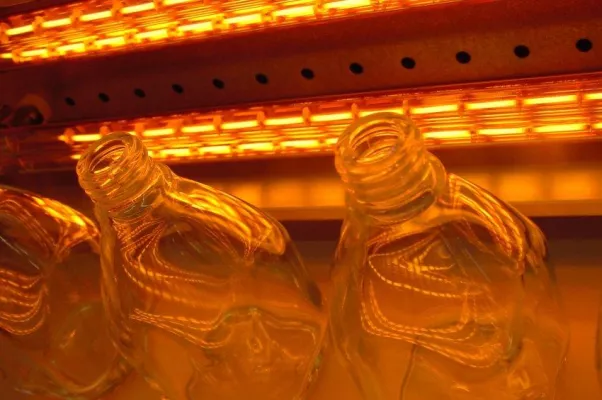
On a glass blowing line, timing and temperature aren’t dials you can fiddle with when you feel like it. The furnace has to hit setpoints quickly, sit on them without wandering, and cycle clean between batches. If it drifts, you see it fast—thin walls, necks that run off-center, and thermal stress that can show up later as spontaneous fracture. We built our Industrial heating modules around that reality. What matters under the hood We run quartz short-wave infrared emitters because they deliver high power density with low thermal mass. Response is measured in seconds, not minutes, so the furnace tracks setpoint without overshoot. The emitters are set up for 230/400 V and are rated for continuous duty on 24/7 lines. Standardized mounting and terminal boxes keep integration straightforward. Emissivity is tuned for glass, and the heating layout is engineered to give a uniform thermal field—fewer hot spots and cold zones that otherwise make viscosity act up during forming. Why this plays well on the line Fast response cuts heat-up and cool-down time, and that directly boosts throughput. Tight temperature control keeps viscosity repeatable from piece to piece, so the blow mold sequence behaves the same at the start of the shift and at the end. The payoff is fewer reworked blanks, less scrap, and a yield that doesn’t yo-yo. Energy use drops too, because the system heats only when it needs to and holds temperature without chasing it, trimming idle losses during standby. A few shop-floor details Installation is straightforward on most furnace retrofits, but opening geometry and airflow matter. Keep clearance around the emitters so the housing doesn’t cook, and make reflector cleanliness part of routine maintenance. If you’re running high-lead or specialty glasses with different absorption behavior, we retune the emitter spectrum and power density to match.