


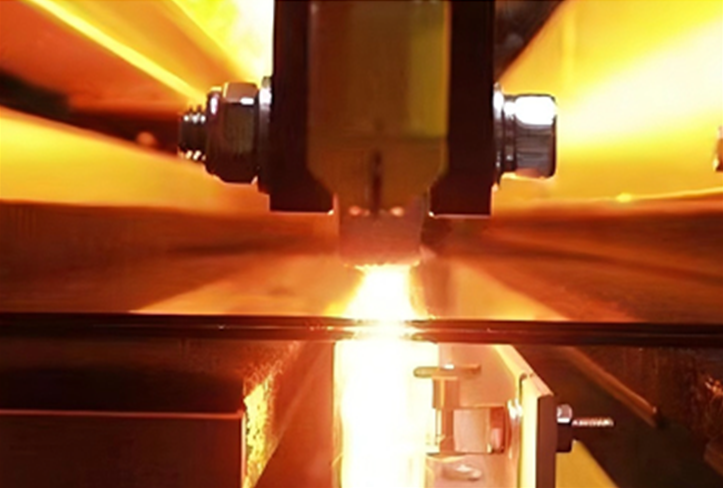
On the glass line, paint drying is more than just solvent evaporation. It’s a thermal process that has to respect the substrate. When convection ovens drag out cycle time, or uneven heat leaves solvent trapped and coatings blister, you bleed yield—and you risk thermal stress fractures in tempered or bent parts. Infrared (IR) drying flips that constraint into control. What matters, technically IR drying works because the energy goes straight into the coating and is absorbed at the interface, not dumped into the furnace air. We match the emitter spectrum to the paint’s emissivity and the cure profile: short-wave for a fast surface set, medium-wave for deeper penetration, and NIR when the line won’t wait. A typical module runs at 230 V or 400 V, with power density chosen to fit line speed and part geometry, and a focused heat zone that keeps the glass below the threshold where thermal stress starts to bite. The payoff is predictable temperature curves, not guesswork. Why it fits glass processing In tempering, bending, and coating lines, throughput and repeatability make the numbers. IR drying shrinks the drying window, so the coater doesn’t become the bottleneck. You get a more uniform thermal field across the pane, which means fewer rejects from uneven gloss, adhesion failure, or solvent pop. Energy use drops because the heat is only on when glass is in the zone, and there’s less idle mass to warm. For tempered parts, that controlled heat also cuts the risk of spontaneous breakage from edge stress. Here are the practical details IR is line-of-sight, so geometry matters. Emitter placement and distance have to be tuned to avoid shadows and edge overheat, and the conveyor needs to hold the glass stable enough to keep that distance consistent. Paint formulation changes the absorption profile, so validate the cure schedule with thermocouple data on actual parts. Plan for reflector maintenance and keep spare lamps on hand; when you’re running 24/7, a 15-minute swap beats a two-hour oven shutdown.