
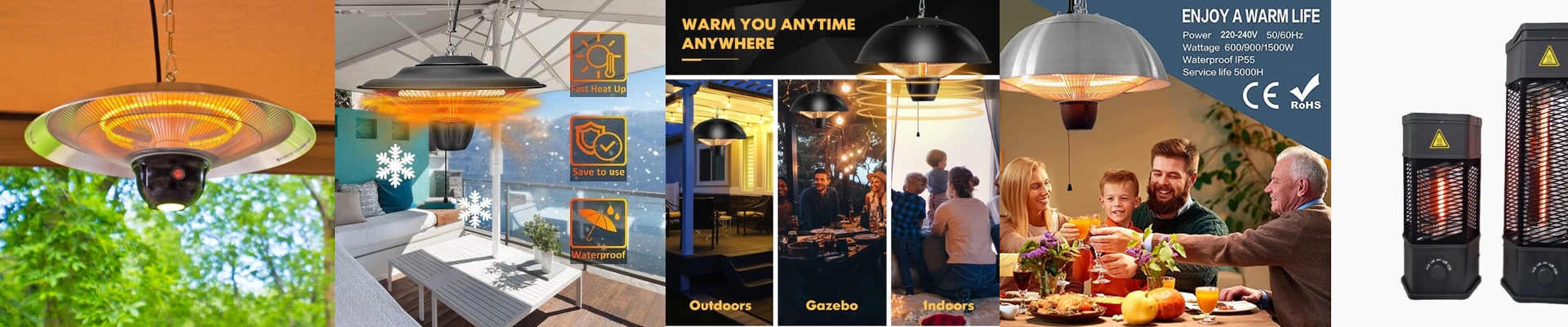



Introduction
Here’s the idea behind our heavy-duty infrared heaters: they give off warmth that feels like sunlight—direct, focused, and immediate. We built them to put intense heat exactly where you need it, without wasting energy heating the whole room. And that deep warmth? It doesn’t just warm the air—it reaches into your muscles and joints, helping you move easier and feel more energized.
Power, Voltage, and Heat—Plain Talk
Infrared heating is all about power and how densely it’s delivered. Our heavy-duty units use shortwave infrared halogen elements that blast out heat in a tight, directional beam. You choose the voltage and wattage to match your space and your workload, and the heater comes alive instantly—no waiting around, no moving parts to wear down. Why do voltage and wattage matter so much? Because more wattage means more heat, faster. You can cover bigger areas or tackle tough spots with ease. But that power comes with responsibility. Higher wattage means higher current, and your wiring, controls, and panel need to be built for continuous, heavy use—not just occasional duty.
Built to Last: Halogen, Quartz, and Smart Connections
Inside, you’ve got a halogen-filled quartz tube. The halogen keeps the filament stable, so output stays consistent over time. Quartz handles the extreme heat and lets infrared energy pass through cleanly. We shape the beam with a carefully chosen coating and reflector setup, protecting the element and directing the heat where you want it. Then there’s the R7s connector. It’s there for a reason: it holds tight at high temperatures and survives the constant on/off cycling of real-world use. Out on the shop floor, a loose connection is a weak link—one that heat can easily turn into a failure. R7s keeps things secure and makes installation straightforward, every time. One practical note: the closer the heat source, the stronger the intensity. That’s great for targeted warmth, but you’ve got to respect clearances and shielding. Keep anything flammable at a safe distance, and follow the mounting instructions.
What It Feels Like—and Why It Works
This kind of heating mimics the warmth of the sun. The infrared energy reaches past the surface, warming tissue at a deeper level. That boost in circulation can loosen stiff joints and cut down on fatigue, especially during cold shifts. It also helps support metabolic activity in muscles and connective tissue, so you stay more comfortable and less dragged down when the temperature drops. In industrial settings, these heaters are built to take a beating—dust, vibration, long hours, the whole nine yards. For engineers, that means predictable performance, wiring that plays nicely with standard setups, and a unit that can be spec’d as a simple drop-in upgrade. The catch is heat management: high output means you need proper ventilation and cooling around the unit, so it runs steady and protects nearby equipment.